

Our Blog Details

  • Post By
  • Date
    January 29, 2026
  • Comments
    0
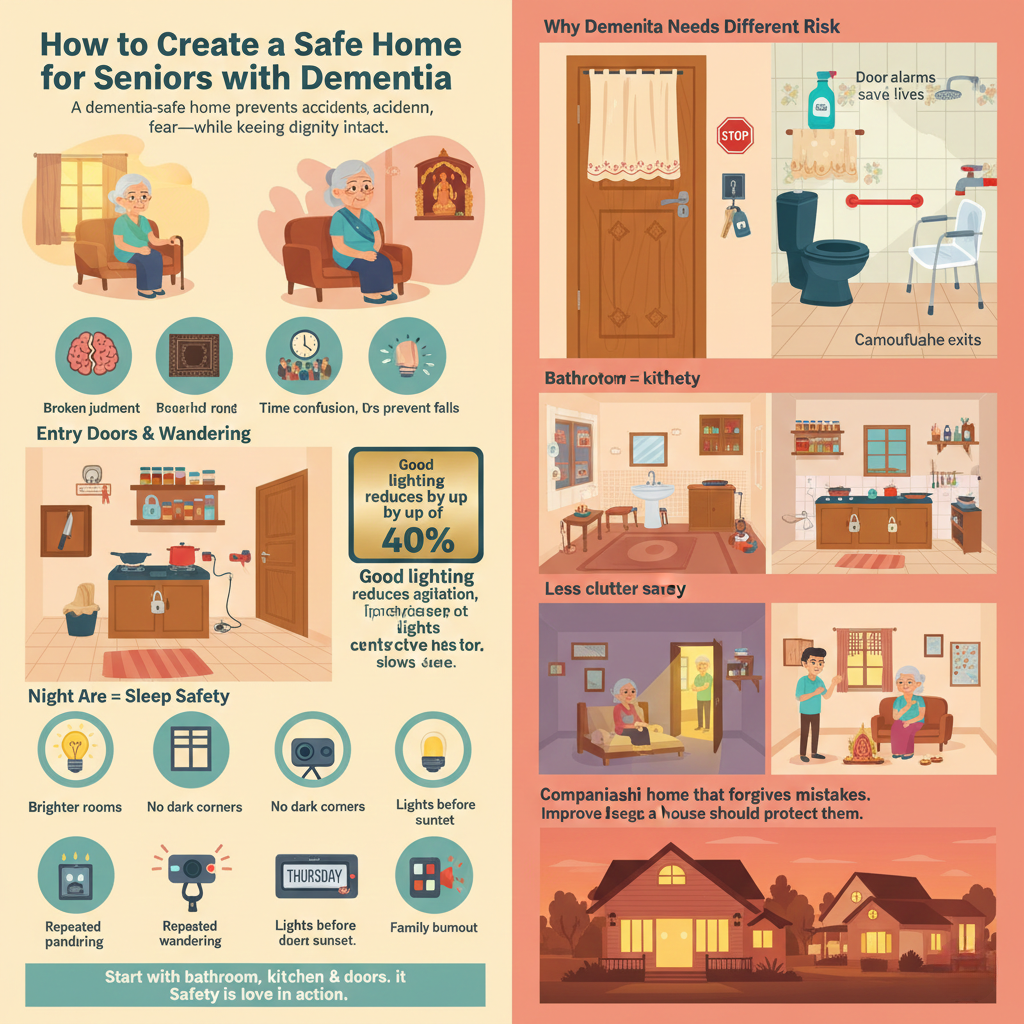
A dementia-safe home removes physical hazards, prevents wandering, uses color contrast for visibility, and maintains consistent routines through environmental design. The goal is simple: create a space where your parent cannot accidentally harm themselves, even when their judgment fails. This means treating the home like you would for a toddler, but with dignity and without making it feel like a hospital. This guide provides room-by-room modifications tested in real Indian homes, practical solutions that cost less than ₹10,000, and professional insights from years of dementia care experience at Pranyaas.

Why Dementia Needs a Different Approach to Home Safety

Standard elderly care focuses on mobility and fall prevention. Dementia care adds another layer: protecting someone from their own confused decisions. A senior with arthritis might move slowly but still knows not to drink floor cleaner. A senior with dementia might see a blue liquid and think it’s Rooh Afza. This fundamental difference changes everything about home safety. What dementia affects:

Judgment

Cannot assess danger accurately

Depth perception

Dark rugs look like holes, shiny floors look wet

Recognition

May not recognize family members or their own reflection

Time orientation 

Tries to “go to office” at 3 AM

Impulse control

Acts on thoughts without considering consequences If you’ve noticed these changes in your parent, you may have already identified some of the 10 Warning Signs Your Elderly Parent Needs a Professional Caregiver. Environmental modifications should begin immediately before an accident forces emergency decisions.

What to Fix, Room by Room

Entry Points and Doors

Wandering is the most dangerous dementia behavior. Your parent might leave at 2 AM looking for their childhood home, or try to “pick up children from school,” children who are now 50 years old. Practical modifications:

Camouflage the exit door

Paint it the same color as the surrounding walls, or hang a curtain over it. If the door doesn’t look like a door, they won’t try to open it.

Install locks out of sight line

Place slide bolts very high (near the top of the door) or very low (near the floor). Dementia patients typically only look at eye level.

Add door alarms

Simple magnetic sensors (₹300–500 online) alert you when any door opens.

Remove keys from visible spots

Never leave keys on hooks near doors or in locks.

Use a “STOP” sign 

A red stop sign on the inside of exit doors can trigger automatic hesitation. What doesn’t work: Reasoning with them about why they shouldn’t leave. Their brain cannot process that logic anymore. Environmental barriers work better than conversations.

Bathroom Safety: The Highest Risk Area

Caregiver helping elderly woman in a dementia-safe bathroom at home. Bathrooms cause the most injuries for dementia patients. Wet surfaces, hard edges, confusing fixtures, and privacy expectations create a dangerous combination. Practical modifications:

Contrasting toilet seat

If your toilet and floor are both white, install a colored seat (dark blue or black). Dementia patients literally cannot see a white toilet on a white floor.

Grab bars everywhere

Near the toilet, inside the shower area, next to the sink. These cost ₹500–1,500 each and prevent the most common falls.

Remove or cover mirrors

In later stages, patients don’t recognize their reflection. They may think a stranger is watching them, causing panic or aggression.

Label hot water clearly

Use red tape or a sign on the hot water tap. Lower the geyser temperature to 40°C maximum to prevent scalding.

Outside-openable lock

Replace the bathroom lock with one that can be opened from the outside. If they fall or lock themselves in, you need access.

Shower chair

Eliminates standing while bathing. Non-negotiable for anyone with balance issues.

Remove all medicines and chemicals

Nothing should be accessible in the bathroom except soap and towels. Indian toilet consideration: If your home has an Indian-style toilet, consider switching to a Western commode or using a portable commode chair. Squatting requires balance and judgment that dementia patients lack.

Kitchen Safety: Managing Fire, Sharp Objects, and Chemicals

The kitchen combines everything dangerous: fire, knives, chemicals, glass, and electrical appliances. Memory loss means your parent might put plastic containers on a lit stove or drink phenyl, thinking it’s medicine. Practical modifications:

Gas stove with auto-shutoff

Install a stove with a Flame Failure Safety Device (FFSD) that cutsthe gas if the flame goes out. Costs ₹3,000–8,000.

Hidden master switch

Install a switch for the gas line or induction cooktop in a location they won’t find. Turn it off when not supervising.

Lock chemicals separately

Phenyl, bleach, dishwashing liquid, and rat poison all must be locked in a high cabinet or separate room.

Replace glass with melamine

Switch to unbreakable plates, glasses, and bowls. If dropped, nothing shatters.

Remove or lock knives

Keep only one butter knife accessible if needed.

Solid colored plates

Patterned plates confuse dementia patients. They may try to “pick up” flowers printed on the plate. Use plain white or colored plates.

Unplug small appliances, Mixer, toaster, and kettle

Keep them unplugged and stored when not in use. Pranyaas’ insight: Many families resist removing cooking access because their parent “loves to cook.” A safer approach: let them participate in supervised cooking tasks like stirring or washing vegetables, while controlling access to fire and knives.

Living Areas: Reducing Confusion and Falls

Cluttered, dark, or overstimulating living spaces increase confusion and agitation. Simplifying the environment calms the dementia brain. Practical modifications:

Remove loose rugs

Any rug that isn’t secured to the floor is a tripping hazard. Dark rugs on light floors look like holes to dementia patients.

Clear walking paths

Create obstacle-free routes between the bedroom, bathroom, and living area. Remove decorative items from floor level.

Reduce furniture

Keep only essential pieces. Too many objects cause sensory overload.

Secure wobbly furniture

Any chair or table that moves when leaned on must be replaced or secured.

Cover or remove glass tables

Transparent surfaces are invisible to dementia patients. They may walk into them or place items “on” them and watch them fall.

Simplify remote controls

Too many buttons cause frustration. Consider a simplified universal remote with only essential buttons.

Supporting Sleep and Night Safety

Night wandering and falls during bathroom trips are common. The bedroom setup should support safe movement in darkness. Practical modifications:
  • Motion-sensor night lights –  Install in the bedroom, hallway, and bathroom. Lights activate automatically when they get up.
  • Bed height adjustment – The feet should touch the floor when sitting on the bed edge. Too high means falling while getting down; too low means difficulty standing up.
  • Firm mattress – Soft mattresses make it hard to get up and increase fall risk.
  • Clear path to bathroom – Nothing between the bed and the bathroom door. Leave the bathroom light on or the door open at night.
  • Bed rails (with caution) – Can prevent rolling off, but can also cause entrapment. Use only if recommended by a doctor.
  • Phone within reach – Landline or simple mobile phone next to bed for emergencies.
  • Simplified wardrobe – Keep only 4–5 outfit options visible. Too many choices cause anxiety and frustration.

The Most Underestimated Safety Factor

Poor lighting creates shadows. To a dementia brain, shadows look like objects, holes, or people. This triggers fear, confusion, and the evening agitation called “sundowning.” Lighting rules for dementia homes:
  • Increase brightness – Seniors need 2–3 times more light than younger adults. Replace 40W bulbs with 100W equivalents.
  • Even distribution – No dark corners. Light the entire room uniformly to eliminate shadows.
  • Reduce glare – Shiny floors and surfaces create reflections that look like water or obstacles. Use matte finishes where possible.
  • Night lighting – Motion-activated lights prevent stumbling during night bathroom trips.
  • Close curtains before sunset – Windows become mirrors at night. Your parent may see their reflection and think someone is outside.
  • Transition lighting – Turn on indoor lights before it gets dark outside. Sudden darkness triggers sundowning.
Proper lighting alone can reduce 30–40% of confusion-related incidents. It’s the cheapest and most effective modification you can make.

Technology for Dementia Safety

Modern technology offers affordable monitoring without being intrusive:
  • Door and window sensors – Alert your phone when opened (₹500–1,000)
  • Indoor cameras – WiFi cameras (Mi, Godrej, CP Plus) let you check on them remotely (₹1,500–3,000)
  • GPS trackers – Small devices for pocket or shoe if wandering risk is high (₹2,000–5,000)
  • Dementia clocks – Display day, date, time, and “Morning/Afternoon/Night” in large text (₹1,500–3,000)
  • Medication dispensers with alarms – Automatic reminders for medicine times (₹1,000–2,500)
  • Video doorbells – See who is at the door and speak remotely (₹3,000–8,000)
Technology supplements supervision but doesn’t replace it. If you’re considering whether home modifications are enough or if your parent needs a different care setting, understanding Home Care vs. Assisted Living: What is the Best Choice for Your Parent? can help you evaluate options.

When Home Modifications Aren’t Enough

Even the safest home cannot compensate for:
  • 24/7 supervision needs – If they cannot be left alone for even 30 minutes
  • Physical aggression – If they become violent during confusion episodes
  • Advanced wandering – If they’ve successfully left the house despite precautions
  • Complex medical needs – If dementia is combined with diabetes, heart disease, or post-surgery care
  • Caregiver exhaustion – If family members are burning out
At this stage, professional dementia care becomes necessary. Pranyaas provides trained caregivers who understand dementia behaviors, de-escalation techniques, and safety protocols specific to memory care. For comprehensive guidance on managing all aspects of elder care, including when to bring in professional help, read our A Family’s Complete Guide to Elderly Care at Home in India.

What the Numbers Say About the Risk

Risk Factor Data Source
Dementia population in India 8.8 million people are currently living with dementia Alzheimer’s and Related Disorders Society of India (ARDSI)
Fall risk increases Dementia patients are 8x more likely to fall than seniors without cognitive issues Indian Journal of Psychiatry
Wandering prevalence 6 out of 10 dementia patients will wander at least once Alzheimer’s Association
Fatal wandering outcomes 50% of wanderers who aren’t found within 24 hours face serious injury or death National Health Portal India
Kitchen and bathroom injuries 70% of dementia-related home accidents occur in these two rooms HelpAge India
These numbers show why waiting to modify the home is risky. One fall, one wandering incident, or one kitchen accident can change everything permanently.

The Role of Companionship in Dementia Safety

A safe environment is only one part of dementia care. Loneliness and lack of mental engagement accelerate cognitive decline and increase behavioral problems. Seniors with dementia who have consistent companionship show:
  • Reduced agitation and aggression
  • Better sleep patterns
  • Slower progression of confusion
  • Fewer wandering attempts
This is why The Importance of Companionship for Senior Mental Health matters as much as physical safety modifications. A caregiver who engages your parent in conversation, activities, and emotional connection provides safety that no lock or alarm can offer.

Conclusion

Creating a dementia-safe home is not a one-time project. As the condition progresses, new hazards appear, and old solutions stop working. What works in early-stage dementia may be insufficient in later stages. The core principle remains constant: build an environment that forgives mistakes. If they drop something, it shouldn’t break. If they wander, they shouldn’t reach the street. If they forget the stove, the house shouldn’t burn. Start with the highest-risk areas like the bathroom, kitchen, and exit doors. Add lighting improvements throughout. Then address specific behaviors as they appear. However, the safest home still requires supervision. Environmental modifications reduce risk but don’t eliminate it. If your family is struggling to provide constant oversight, professional dementia care is the logical next step. Contact Pranyaas for a dementia care assessment. Our care managers can evaluate your home for safety risks and recommend trained caregivers who understand memory care. You don’t have to manage this alone.

Frequently Asked Questions

How do I stop my dementia patient from wandering out of the house?

Camouflage exit doors by painting them the same color as the walls or hanging curtains over them. Install locks very high or very low where they won’t be seen. Add door alarms that alert you when doors open. Use a red STOP sign on the inside of doors. Never leave keys visible near exits.

What colors are best for a dementia-friendly home?

Use contrasting colors to help visibility. Dark toilet seats on light floors, colored plates on white tables, bright bedsheets on dark floors. Avoid all-white environments where objects blend. Avoid busy patterns that confuse. Solid, contrasting colors work best.

Why does my parent with dementia get scared of the bathroom?

Common reasons include dark tiles that look like deep water, mirrors showing an unrecognized reflection, echoing sounds that feel threatening, or cold surfaces causing discomfort. Cover mirrors, add warm lighting, use bath mats for color contrast, and keep the bathroom warm before bathing.

Is it safe to leave a dementia patient alone at home?

No, leaving someone with moderate to advanced dementia alone is not safe. They cannot respond appropriately to emergencies, may wander, or may accidentally harm themselves. If family supervision isn’t possible full-time, professional caregiver support is necessary for safety.

How much does it cost to make a home dementia-safe in India?

Basic modifications cost ₹5,000–15,000 total. This includes grab bars (₹500–1,500 each), door alarms (₹300–500), night lights (₹200–500 each), colored toilet seat (₹500–1,000), and cabinet locks (₹200–400). Major changes like switching to induction cooking or Western toilets cost more but aren’t always necessary.

Leave A Comment

Need Any Helps ?

Get More Consultations