


Our Blog Details

  • Post By
  • Date
    January 29, 2026
  • Comments
    0
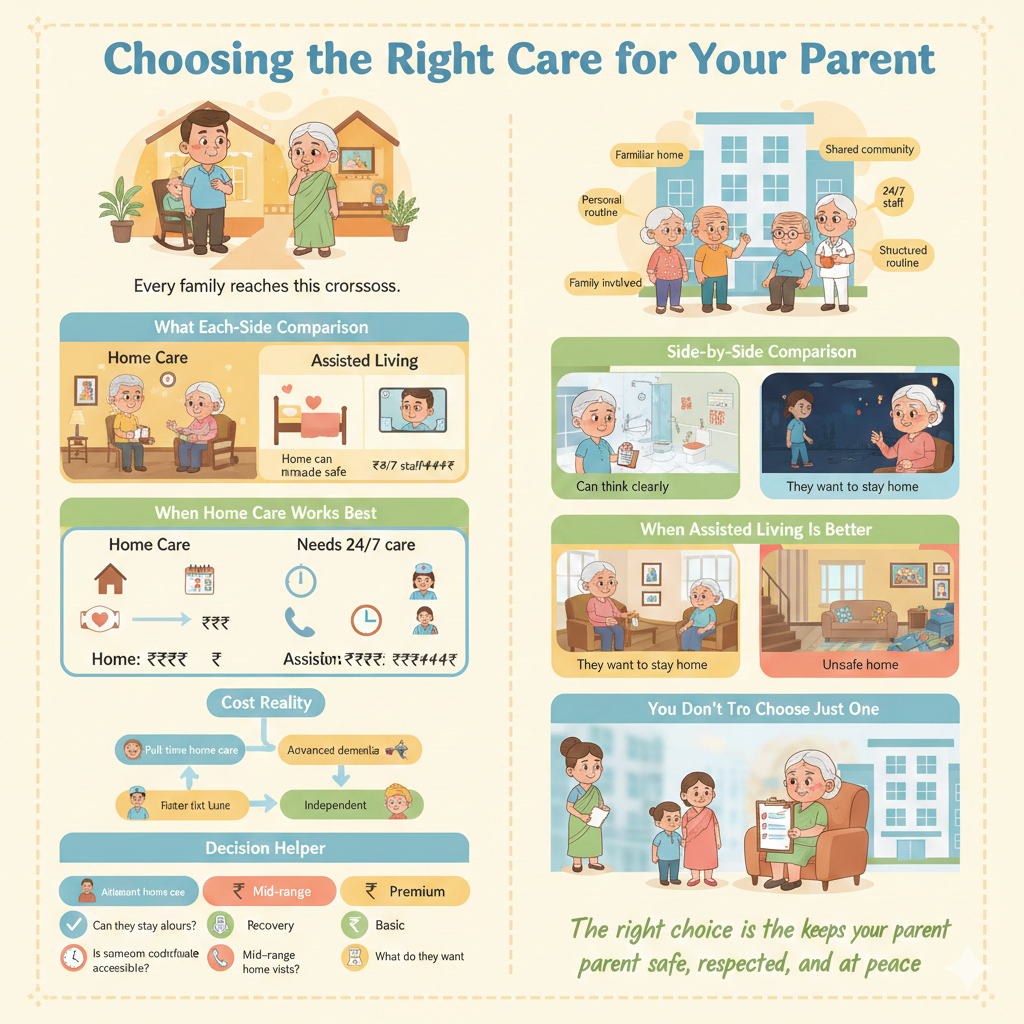
Home care is more effective when your parent is cognitively stable, the home is made safe, and family oversight is available. Assisted living is preferable when 24/7 medical supervision is required, the home cannot be modified, or family caregivers are unavailable. There is no universally correct answer. The right choice depends on your parents’ health condition, your family’s capacity, the home environment, and financial resources. This guide provides a practical framework for making this decision based on real factors that matter, not guilt or social pressure.

Why This Decision Feels So Difficult

Family meeting with caregiver to decide elderly care options. Most Indian families struggle with this choice because of emotional weight, not lack of information. Moving a parent to assisted living feels like abandonment. Keeping them at home feels like a burden you’re failing to manage. Neither feeling reflects reality, but both influence decisions. The goal is to remove emotion temporarily and assess the situation practically. What does your parent actually need? What can your family actually provide? Where are the gaps? If you’ve already noticed concerning changes in your parents’ health or behavior, reviewing the 10 Warning Signs Your Elderly Parent Needs a Professional Caregiver can help clarify the level of care required.

What’s the Real Difference Between Home Care and Assisted Living?

What Each Option Actually Means

Home Care:

Your parent stays in their own home. Professional caregivers (attendants, nurses, physiotherapists) visit or stay to assist. Family members remain involved in oversight and decision-making.

Assisted Living / Old Age Homes:

Your parent moves to a facility with other seniors. Staff provide meals, medical monitoring, activities, and daily assistance. Family visits but doesn’t manage daily care.

Side-by-Side Comparison

Factor Home Care Assisted Living
Location Parent’s own home Residential facility
Familiarity Known environment, neighbors, routines New environment, new people
Independence Higher — they control their space Lower — follows the facility schedule
Personalization Care plan tailored to the individual Standardized care for all residents
Social interaction Depends on caregiver and family visits Built-in community of peers
Medical access Arranged as needed (doctor visits, nursing) Usually on-site or nearby
Family involvement High — daily coordination required Lower — facility manages daily care
Cost (metro cities) ₹25,000–60,000/month for full-time care ₹30,000–1,50,000/month depending on facility
Flexibility High — can adjust care as needs change Lower — bound by facility policies
Neither option is inherently superior. The right choice depends on your specific situation.

When Home Care is the Better Choice

Home care works best when certain conditions are met:

They can still think clearly and make basic decisions

If your parent can make basic decisions, recognize family members, and follow daily routines with reminders, home care provides appropriate support without unnecessary restrictions. For parents with early-stage memory issues, home modifications can maintain safety. Read How to Create a Safe Home Environment for Seniors with Dementia for specific guidance.

The Home Can Be Made Safe

Home care requires a safe physical environment:
  • The bathroom can accommodate grab bars and shower chairs
  • No major fall hazards that cannot be removed
  • The kitchen can be secured if needed
  • Entry/exit points can be monitored
If the home is a third-floor walkup with no lift, narrow doorways that can’t fit wheelchairs, or structural issues that prevent modifications, assisted living may be more practical.

Someone in the family can stay involved

Home care works when someone, whether locally or remotely, can:
  • Coordinate with caregivers and doctors
  • Handle emergencies or caregiver absences
  • Make medical decisions
  • Visit periodically for quality checks
NRI families successfully manage home care through professional services like Pranyaas that provide care coordination, regular updates, and emergency response.

They want to stay home

Respecting your parents’ preferences matters for their mental health and cooperation with care. Forcing someone into assisted living against their will often leads to depression, refusal to participate, and faster decline.

When Assisted Living Becomes the Better Option

Assisted living becomes appropriate when home care cannot meet the need:

24/7 Medical Supervision is Required

Some conditions require constant clinical monitoring:
  • Advanced dementia with wandering and aggression
  • Post-stroke care requires intensive rehabilitation
  • Multiple organ issues needing coordinated medical management
  • Severe diabetes with frequent hypoglycemic episodes
If your parent needs a nurse or doctor available at all times, not just visiting, assisted living with medical infrastructure may be necessary.

Complete Social Isolation at Home

If your parent:
  • Lives alone with no nearby family
  • Has lost spouse and most friends
  • Refuses to leave the house
  • Shows signs of depression from loneliness
Then the built-in community of assisted living can provide social engagement that home care cannot replicate. Loneliness accelerates cognitive and physical decline, as explained in The Importance of Companionship for Senior Mental Health. However, before choosing assisted living for social reasons, consider that quality home care includes companionship. Pranyaas caregivers are trained to provide meaningful interaction, not just physical assistance.

The Home is Fundamentally Unsafe

Some homes cannot be made safe:
  • Multiple floors with no way to live on ground level
  • Remote location with poor access to hospitals
  • No space for a live-in caregiver
  • Family circumstances that create unsafe dynamics
In these cases, moving to a purpose-built facility may be safer than adapting an unsuitable home.

No Family Caregiver Available Even for Oversight

Home care requires some level of family involvement, even if it’s remote coordination. If genuinely no family member can be involved, not even for monthly visits or phone check-ins, institutional care provides a complete solution.

You Don’t Have to Choose Just One

Most families don’t choose purely one option. They combine approaches based on changing needs: Common patterns:
  • Start with part-time home care – Increase to full-time as needs grow
  • Home care during recovery – Return to independent living when stable
  • Home care with respite stays – Occasional short stays in facilities when the family needs breaks
  • Home care trial – Move to assisted living if it doesn’t work
  • Assisted living with home visits – Parent lives in facility but spends weekends at home
The “either/or” framing is often false. Care arrangements can evolve.

What Will You Actually Pay?

Home care costs

Service Type Metro Cities Tier 2 Cities
Part-time attendant (8 hours) ₹15,000–25,000/month ₹10,000–18,000/month
Full-time live-in caregiver ₹25,000–45,000/month ₹18,000–30,000/month
Trained nurse (8–12 hours) ₹35,000–60,000/month ₹25,000–40,000/month
24/7 nursing care ₹70,000–1,20,000/month ₹50,000–80,000/month
Additional home care costs:
  • Doctor home visits: ₹800–2,000 per visit
  • Physiotherapy: ₹500–1,500 per session
  • Medical equipment (hospital bed, oxygen): ₹3,000–15,000/month rental
  • Home modifications: ₹5,000–50,000 one-time

Assisted Living Costs

Facility Type Monthly Cost Range
Basic old age home ₹15,000–30,000/month
Mid-range assisted living ₹35,000–70,000/month
Premium senior living community ₹80,000–2,00,000/month
Nursing home with medical care ₹60,000–1,50,000/month
What’s typically included:
  • Accommodation and meals
  • Basic medical monitoring
  • Housekeeping and laundry
  • Common area activities
  What costs extra:
  • Specialized nursing care
  • Physiotherapy
  • Personal attendant
  • Premium rooms
Cost reality: Quality home care and quality assisted living cost similar amounts. The deciding factor shouldn’t be money alone; it should be which option better serves your parents’ needs.

Questions That Will Help You Decide

Use these questions to guide your decision:

About their health

  1. Can they be left alone for 2-3 hours safely?
  2. Do they need medical monitoring more than once daily?
  3. Are they cognitively stable enough to follow basic routines?
  4. Do they have conditions that could require an emergency response at any moment?

About Your Home

  1. Can the bathroom be made accessible?
  2. Is the bedroom on an accessible floor?
  3. Is there space for a caregiver to stay if needed?
  4. Is a hospital reachable within 30 minutes?

About Your Family

  1. Can someone (even remotely) coordinate care daily?
  2. Is there backup if the primary coordinator is unavailable?
  3. Can someone visit at least monthly?
  4. Is there family conflict that would affect home-based care?

About Your Parents’ Preferences

  1. Have you asked them directly what they want?
  2. Are they willing to accept help at home?
  3. Have they visited any assisted living facilities?
  4. What matters most to them –  independence, safety, or social connection?
If most answers point toward home being manageable, start with home care. If most answers suggest home care won’t work, assisted living deserves serious consideration.

What the Numbers Say About Elder Care in India

Factor Statistic Source
Senior population growth India has 158 million seniors (11.1% of the population), projected to reach 347 million by 2050 UNFPA India Ageing Report
Preference for home care 78% of Indian seniors prefer to age in their own homes Longitudinal Ageing Study in India (LASI)
Living alone or with a spouse only 26% of urban elderly live without adult children present JLL Senior Living Report 2024–25
Chronic illness prevalence 75% of elderly Indians have at least one chronic condition Ministry of Health and Family Welfare
Home healthcare market Projected to reach USD 15.51 billion by 2030 TechSci Research India
Assisted living facilities Only 1% of Indian seniors currently live in institutional care HelpAge India Report
  This data shows that while most seniors prefer home care, the support infrastructure for home-based care is growing rapidly to meet this demand.

How to Start with Simple, Practical Steps

If Considering Home Care:

  1. Assess current needs – Use the checklist in our A Family’s Complete Guide to Elderly Care at Home in India
  2. Evaluate home safety – Identify required modifications
  3. Calculate costs – Include caregiver, medical visits, equipment
  4. Identify coordination capacity – Who will manage day-to-day oversight?
  5. Start with a trial period – Begin with part-time care before committing to full-time
Pranyaas offers free consultations to help you assess whether home care is feasible for your situation.

If Considering Assisted Living:

  1. Visit multiple facilities – Don’t choose based on brochures alone
  2. Talk to current residents and families – Ask about experience, not marketing
  3. Check medical capabilities – What emergencies can they handle on-site?
  4. Understand total costs – Ask about hidden charges for extra services
  5. Plan transition carefully – Sudden moves increase confusion and distress

Conclusion

The choice between home care and assisted living is not about what’s “better” in general. It’s about what’s better for your parent, your family, and your circumstances. Home care works when the environment is safe, family oversight is available, and your parent prefers familiar surroundings. Assisted living works when medical needs exceed what home care can provide, isolation is severe, or the home cannot be made safe. Most families start with home care and adjust as needs change. Some eventually transition to assisted living. Others never need to. Both paths can be right. What matters is making the decision based on practical assessment, not guilt. Your parent deserves care that matches their actual needs. You deserve a care arrangement that’s sustainable for your family. If you’re unsure whether home care can meet your parent’s needs, Contact Pranyaas for a care assessment. We can help you evaluate options honestly, including telling you when assisted living might be the better choice. The goal is your parents’ well-being, not any particular care setting.

Frequently Asked Questions

Is home care better than old age home for elderly parents in India?

Home care is often preferred because it maintains a familiar environment, personal routines, and family connection. However, it requires a safe home, available caregivers, and family oversight. Old age homes are better when 24/7 medical supervision is needed, or the home cannot be made safe. Neither is universally better it depends on individual circumstances.

How do I decide between home care and assisted living for my parent?

Assess four areas: your parent’s health needs (can they be safely managed at home?), your home environment (can it be made safe?), family availability (can someone coordinate care?), and your parent’s preferences (what do they want?). If most factors support home care, start there. If most point to needing institutional support, consider assisted living.

What is the cost difference between home care and assisted living in India?

Quality home care costs ₹25,000–60,000 monthly for full-time support in metro cities. Quality assisted living costs ₹35,000–1,50,000 monthly, depending on facility level. The costs are often similar for comparable care quality. Choose based on care needs, not cost alone.

Can dementia patients be cared for at home, or do they need nursing homes?

Early to moderate dementia can be managed at home with proper safety modifications and trained caregivers. Advanced dementia with severe wandering, aggression, or complex medical needs may require nursing home care. Many families successfully care for dementia patients at home with professional support throughout the disease progression.

When should I move my elderly parent from home care to assisted living?

Consider the transition when: home care cannot provide required medical supervision, caregiver burnout is affecting care quality, the home cannot be made safe despite modifications, your parent’s loneliness is causing depression despite companionship efforts, or care coordination has become unmanageable for your family.

Leave A Comment

Need Any Helps ?

Get More Consultations