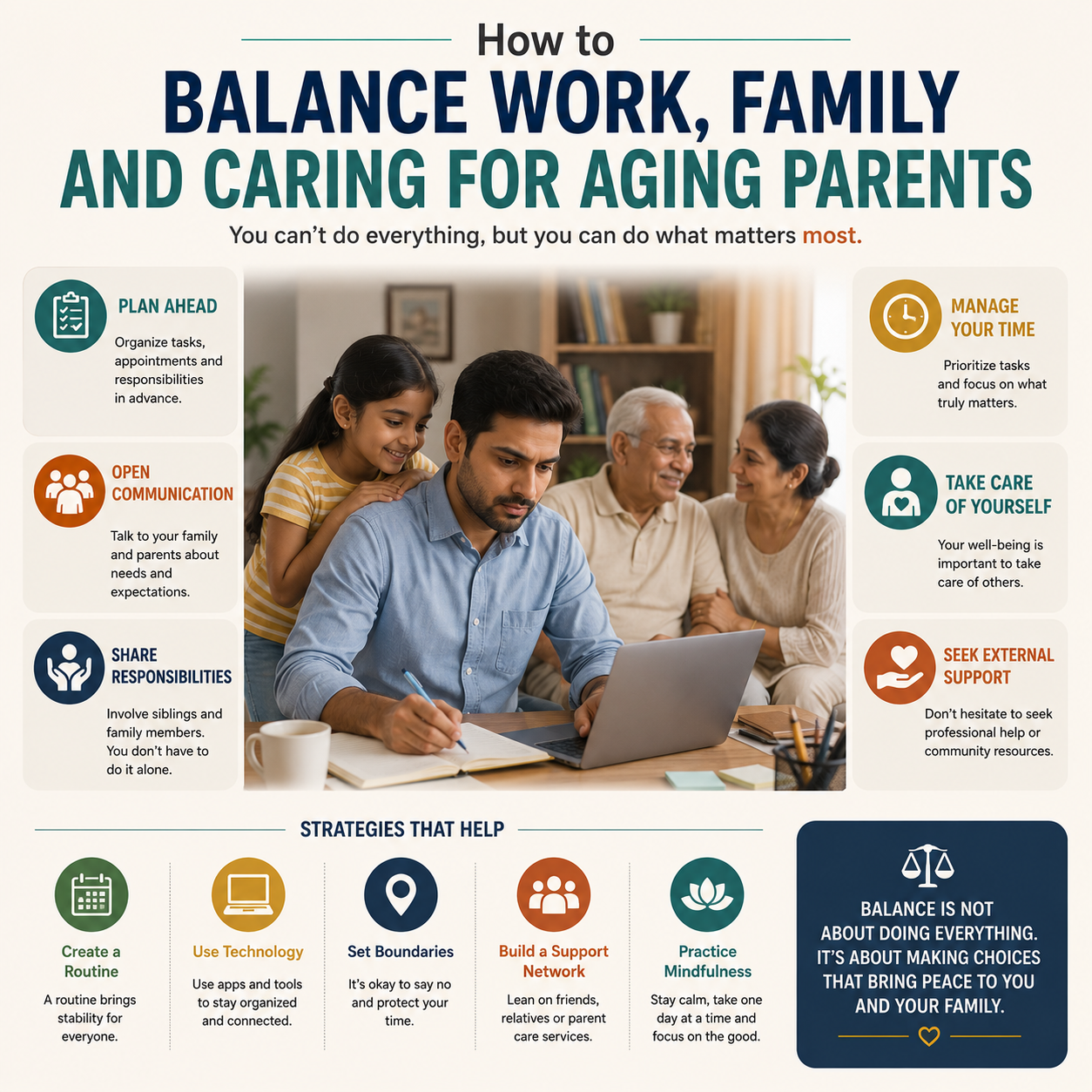
The practical way to balance work, your own family, and an aging parent is to stop treating caregiving as an unlimited personal commitment and start treating it as a plan with named tasks, fixed timings, shared owners, and a defined emergency route. Almost everyone who manages this well has done four things: mapped the real workload, divided it, scheduled it around fixed work commitments, and handed the repeatable parts to reliable support.
Balance here does not mean equal time. It means that none of the three areas is quietly running on emergency mode all the time.
Why This Is Genuinely Hard in India
Most people carrying this load are between their thirties and fifties, at the stage where careers demand the most and children still need supervision. This is often described as the sandwich generation. In India, three further factors sharpen it. Parents frequently live in a different city from where the work is. Extended family may be smaller than it once was. And the cultural default is that a child personally performs care rather than arranges it.
Recognising that the difficulty is structural rather than personal is useful, because structural problems respond to systems, not to trying harder.
Step One: Map the Real Workload Before Trying to Manage It
You cannot balance something you have not measured. For two weeks, note every caregiving task and roughly how long it took, including the invisible ones: phone calls to doctors, chasing test reports, ordering medicines, paying bills, calming a worried parent at night.
Then sort the list into three columns.
- Fixed and predictable: medicine schedules, routine appointments, physiotherapy sessions, bill payments. These can be scheduled and delegated.
- Unpredictable but likely: a sudden fever, a fall, a hospital visit. These need a standing plan, not a calendar slot.
- Only you: decisions, emotional support, family conversations, presence.
Most caregivers discover that the first column takes the most time and is the easiest to hand over. That single realisation usually creates the breathing room.
Step Two: Build a Care Calendar That Respects Your Work Week
The most reliable technique is batching: group predictable caregiving tasks into fixed blocks rather than letting them interrupt the working day at random.
In practice, that means booking routine appointments in one part of the week rather than scattering them, setting a fixed evening for the weekly phone review of health and medicines, keeping medicine refills on a monthly recurring reminder, and giving your parent a predictable time when you are reachable without rushing. Predictability helps them too. Many parents call at awkward hours mainly because they are not sure when they will get your full attention.
Put these blocks in the same calendar as your work commitments. Caregiving that lives only in your head will always feel infinite.
Step Three: Divide Responsibility Instead of Requesting Help
Asking siblings to help produces sympathy. Asking siblings to own specific items produces action. The difference is precision.
A workable division might look like this: one person owns medical coordination, another owns finances and insurance, another owns weekend company or the monthly visit, and the person living closest owns day-to-day oversight, with the others funding paid support to compensate for the imbalance in time.
Siblings living abroad can genuinely own tasks that do not need physical presence, such as insurance renewals, teleconsultation scheduling, bill payments, and keeping the medical file updated. Distance is a reason to redistribute tasks, not to withdraw from them.
Write the division down and revisit it every few months, because care needs change. If you are already past the point where any division of family time would be enough, the more useful question is whether the load itself has become unmanageable. Our article on recognising when caregiving has become too much for one person helps you check that honestly.
Step Four: Use What Your Workplace Actually Allows
Many employees never check their own policy documents. Before assuming nothing is available, look at what your organisation formally offers: flexible or hybrid working, leave categories beyond casual and sick leave, employee assistance programmes, and whether your health insurance allows parents to be added as dependants. Policies differ widely between employers, so the answer is in your own handbook rather than in general advice.
When you do speak to your manager, be specific and forward-looking. A request framed as a defined arrangement, such as leaving early on a fixed day each week, is far easier to approve than an open-ended statement about family difficulties.
Step Five: Protect Your Own Household Deliberately
The people most often shortchanged in this equation are a spouse and children, because they complain least. Two small habits help. Keep at least one part of the week genuinely protected for your own household, and tell your children plainly what is happening in age-appropriate language rather than letting them absorb the tension without explanation.
Involving older children in simple, positive ways, such as a weekly video call with their grandparent, often reduces the sense that the family is being pulled in two directions.
Step Six: Decide What to Hand Over
Outsourcing works best when it targets the tasks that consume time without needing you specifically. For most working caregivers, those are medicine management, accompanying a parent to appointments, health monitoring between doctor visits, daily company, and coordination during a medical emergency.
Support can be as light as a few hours a week. Pranyaas provides healthcare assistance for seniors at home in Mumbai, Navi Mumbai, and Pune, including doctor consultations, medicine delivery, and health monitoring, which removes exactly the layer of coordination that eats into a working day.
Step Seven: Write the Emergency Plan Before You Need It
An emergency plan is what prevents a single bad night from destroying an entire month of work and family commitments. Keep it short and share it with everyone involved: which hospital, who is called first, who has the medical file and medicine list, who has spare keys, and which neighbour can reach your parent within minutes. Add the national helpline for senior citizens, Elderline on 14567, which provides information and assistance across India.
Rehearse it once. A plan nobody has read is not a plan.
Where This Sits in the Wider Picture
Work pressure is only one of the strains that families experience as parents age. For the broader view, including emotional load, medical management, home safety, and financial planning, see our complete guide to what caring for aging parents in India really involves.
Frequently Asked Questions
How many hours a week does caring for an elderly parent usually take?
It varies enormously with health status. A largely independent parent may need only a few hours of coordination each week, while a parent recovering from surgery or living with dementia may need continuous supervision. Tracking your own hours for two weeks gives a far more reliable answer than any average.
How do I manage my parents’ care from a different city?
Rely on a local presence rather than phone updates, agree on a fixed reporting rhythm, keep the medical file accessible to you remotely, and name one person in the same city who can act immediately in an emergency.
What if my siblings refuse to share the responsibility?
Shift from expecting fairness to securing coverage. Ask for specific, limited commitments, including financial ones, and if that fails, arrange paid support and raise the cost-sharing question directly. Carrying everything silently usually ends badly for both you and your parent.
Should I move my parents in with me?
It can work well, but it is a genuine decision rather than an automatic answer. Consider whether your home is safe and accessible for them, whether they would lose their own social network, and whether daily supervision is actually available in your household during working hours.
How do I stop work stress and caregiving stress from merging?
Separate them physically and in time where possible: fixed caregiving blocks, a defined reachable window, and a clear emergency plan so that ordinary hours are not spent waiting for something to go wrong.
A Closing Note
Nobody balances this perfectly, and the arrangement that works this year may not work next year, because a parent’s needs change. Care requirements differ for every individual, and decisions about health or living arrangements should be taken with guidance from a qualified medical professional who knows your parent.
If juggling has stopped working, it may be worth reading about the point at which professional elder care becomes the sensible choice.






Leave A Comment