No matter how carefully a family manages daily elderly care at home, health emergencies happen. A sudden fall, an episode of chest pain, a diabetic elder who becomes unresponsive, a parent who cannot speak clearly without warning – these situations test every caregiver in ways that no daily routine can fully prepare them for. What separates a manageable emergency from a catastrophic one is almost always the same thing: knowing what to do in the first few minutes before professional help arrives.At Pranyaas, senior emergency preparedness at home is something our care team discusses with every family from the very beginning of our relationship with them, because the families who handle emergencies best are not necessarily the ones with medical training. They are the ones who have thought through the possibilities in advance, know the warning signs, and have a clear plan ready before they ever need it.This guide covers the most common health emergencies in elderly people at home, what to watch for, what to do immediately, and how to build the preparedness that makes a real difference when every minute counts.
Why Elderly People Face Higher Emergency Risk at Home
Understanding why elderly people are more vulnerable to sudden health crises at home helps caregivers stay appropriately vigilant without becoming paralyzed by anxiety. Several physiological realities of aging combine to make emergencies both more likely and more serious when they occur.Elderly people have reduced physiological reserve, meaning their bodies have less capacity to compensate when something goes wrong. A younger person who becomes dehydrated will feel unwell. An elderly person with the same level of dehydration may become confused, fall, and lose consciousness. This amplification effect means that conditions which would be manageable problems in a younger adult can escalate to genuine emergencies in an elderly person within a matter of hours or even minutes.According to the World Health Organization, older adults are significantly more likely to experience severe outcomes from conditions, including cardiovascular events, respiratory infections, falls, and metabolic crises, than younger adults with the same underlying condition. Chronic conditions like hypertension, diabetes, heart disease, and COPD, which are extremely common in elderly people at home, create an environment where emergencies can develop from what appears to be a minor symptom.This is why warning signs of health crisis in elderly individuals should always be taken seriously, and why waiting to see whether things improve on their own is rarely the right call when a senior shows sudden, unexplained changes in condition.
How to Set Up Your Home for Emergency Readiness Before Anything Happens
The single most effective thing a family caregiver can do for emergency preparedness is prepare before any emergency occurs. Emergency response for older adults living at home is dramatically more effective when information, supplies, and contacts are already organized and accessible.Every home where an elderly person lives should have the following in place at all times:
A written emergency contact list posted visibly in the home that includes the primary care doctor, the nearest hospital with an emergency department, a local ambulance service number, and at least two family members who can be reached at any hour
A current and complete medication list that includes every drug, dose, and prescribing doctor, stored in a consistent and known location where emergency responders can find it quickly
A brief medical history summary noting major diagnoses, recent surgeries, allergies, and any implanted devices like pacemakers that emergency teams need to know about immediately
A basic first aid kit containing bandages, antiseptic solution, a digital thermometer, a blood pressure monitor, a pulse oximeter, and oral rehydration salts
Clear knowledge of the fastest route to the nearest emergency department and whether the nearest hospital has the specialist capability needed for your parent’s specific conditions
At Pranyaas, our care coordinators help families build this emergency readiness kit as part of the broader daily care structure covered in our pillar guide on how to manage daily healthcare needs of an elderly parent at home. Preparedness is not a separate activity from daily care. It is a natural extension of it.
What to Do When an Elderly Parent Falls at Home
Falls are the most common emergency in elderly people at home and one of the most frequently mismanaged. The immediate instinct of most caregivers is to help their parent up as quickly as possible, but this instinct, while well-intentioned, can cause serious additional injury if a fracture or spinal injury has occurred.When your elderly parent falls, the correct immediate response follows this sequence. First, stay calm and speak to your parent clearly and reassuringly. Ask them whether they are in pain and where. Ask them to try moving their fingers and toes. Do not attempt to move them or help them stand until you have assessed whether they can do so without pain.If your parent reports severe pain in the hip, back, neck, or leg, if they cannot move a limb, or if they appear confused or lose consciousness at any point after the fall, call emergency services immediately and do not attempt to move them. Spinal injuries and hip fractures in elderly people are made significantly worse by well-meaning attempts to lift or reposition the person before professional assessment.If your parent is conscious, not in severe pain, and able to move all limbs, you can assist them to a safe position by first helping them roll to their side, then to a sitting position against a stable surface, and only then to standing if they feel able. Take several minutes for each transition rather than rushing. After any fall, regardless of apparent severity, the incident should be reported to the doctor that same day, as many serious injuries, including hairline fractures,s are not immediately painful and can worsen significantly without proper assessment.According to the Centers for Disease Control and Prevention, one in five falls in elderly people causes a serious injury, and many of these injuries are worsened by incorrect post-fall management at home. Reducing fall risk through daily exercise is one of the most evidence-supported preventive strategies available, and our guide on Why Professional Elderly Care at Home Is Important for Aging Parents covers the specific movements that build the balance and leg strength that make falls less likely.
Recognizing and Responding to a Stroke in an Elderly Parent
Stroke is one of the most time-critical emergencies in elderly people, and the difference between a full recovery and permanent disability is frequently measured in minutes. Every family caregiver of an elderly parent should know the FAST recognition method by heart.F stands for Face drooping. Ask your parent to smile. If one side of the face droops or the smile is uneven, this is a warning sign.A stands for Arm weakness. Ask your parent to raise both arms. If one arm drifts downward or cannot be raised, this is a warning sign.S stands for Speech difficulty. Ask your parent to repeat a simple sentence. If speech is slurred, strange, or your parent cannot speak, this is a warning sign.T stands for Time to call emergency services. If any one of these signs is present, call an ambulance immediately. Do not drive your parent to the hospital yourself if an ambulance is available, as paramedics can begin treatment en route and alert the hospital to prepare for a stroke patient, which significantly improves outcomes.While waiting for emergency services, keep your parent calm and in a comfortable position, preferably lying down with the head slightly elevated. Do not give food, water, or any medication during this time. Note the exact time when symptoms first appeared, as this information determines which treatments are available to the medical team.The American Stroke Association confirms that for ischemic stroke, the most common type, effective treatment is available within a specific time window that begins when symptoms first appear. Every minute of delay reduces the options available and the likelihood of full recovery.
What to Do During a Chest Pain Episode in an Elderly Parent
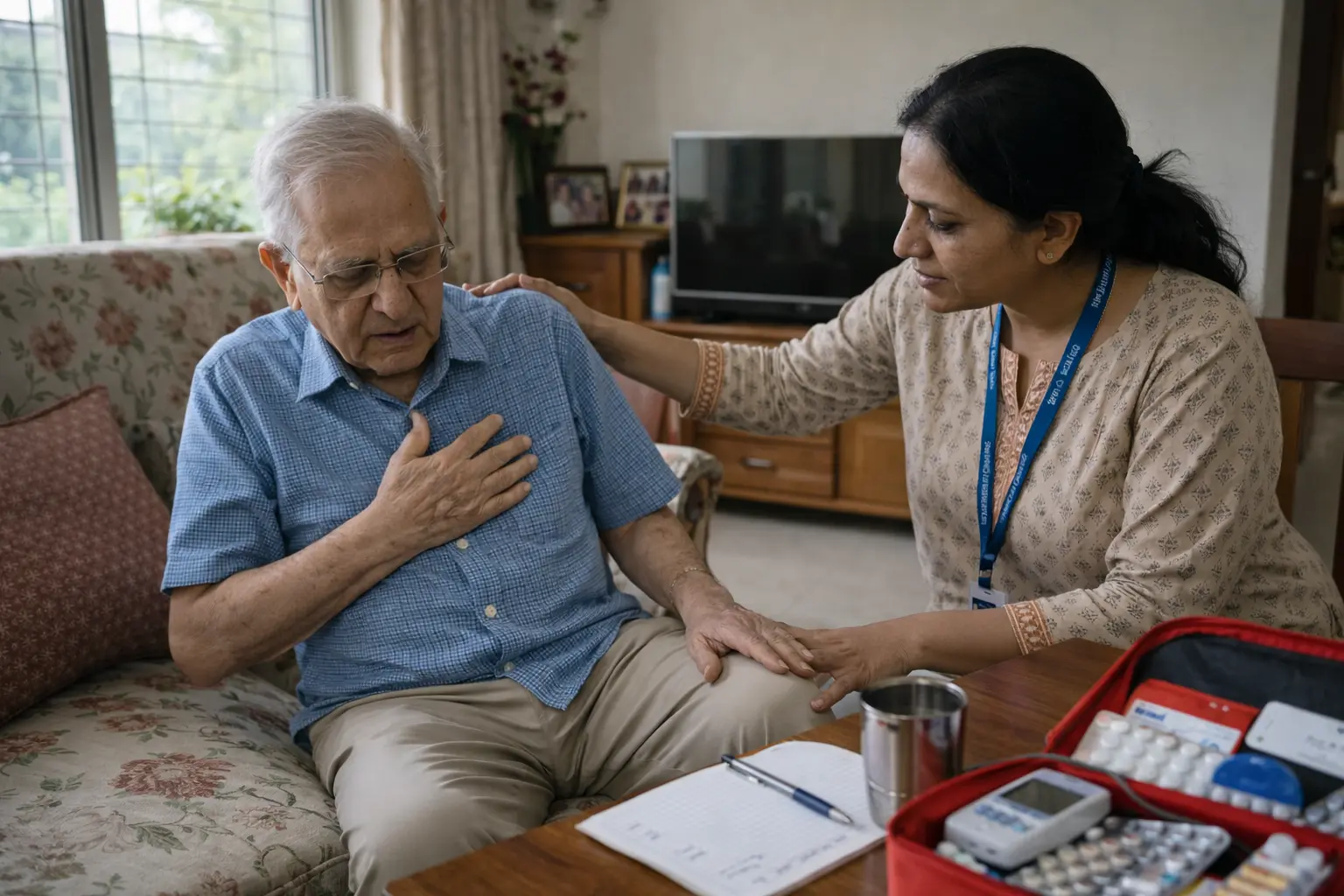
Chest pain in an elderly person should always be treated as a potential cardiac emergency until proven otherwise, even when your parent insists it is indigestion or a muscle strain. Elderly people, particularly women and people with diabetes, frequently experience heart attacks without the classic crushing chest pain described in younger patients. Their symptoms may present as unusual fatigue, jaw pain, shoulder discomfort, nausea, or simply a vague feeling that something is wrong.When your elderly parent reports chest pain or any of the atypical symptoms above, call emergency services immediately. While waiting, have your parent sit or lie in the position they find most comfortable, loosen any tight clothing around the neck and chest, and stay with them. If your parent has been prescribed nitroglycerin by their cardiologist for angina and the pain has not resolved within five minutes of the first dose, call emergency services if you have not already done so.Do not give aspirin unless you have been specifically instructed to do so by the treating doctor in a written emergency plan, as aspirin is contraindicated in certain types of chest emergencies and should not be administered based on general knowledge alone.
Managing a Diabetic Emergency at Home
Diabetic elderly people at home face two distinct types of metabolic emergencies that require opposite responses, making it critical that caregivers understand the difference before either occurs.Hypoglycemia, which is dangerously low blood sugar, typically comes on quickly and presents as sudden sweating, shakiness, confusion, extreme weakness, or, in severe cases, loss of consciousness. If your parent is conscious and able to swallow, give 15 grams of fast-acting sugar immediately. This equals roughly four glucose tablets, half a cup of fruit juice, or three teaspoons of sugar dissolved in water. Wait fifteen minutes and recheck blood sugar. If your parent is unconscious or unable to swallow safely, do not attempt to give anything by mouth. Call emergency services immediately.Hyperglycemia, which is very high blood sugar, develops more slowly over hours or days and presents as excessive thirst, frequent urination, fruity-smelling breath, and increasing confusion or lethargy. This is less immediately dramatic than hypoglycemia but can progress to diabetic ketoacidosis, which is a life-threatening condition requiring hospital treatment. Contact the doctor promptly if your parent’s blood sugar reading is significantly above their target range and they are showing these symptoms.Consistent medication management plays a central role in preventing both types of diabetic emergencies. Our detailed guide on how to give medicine to elderly parents at home without making mistakes covers how to structure a safe and consistent medication routine that reduces the risk of dosing errors that most commonly trigger diabetic emergencies at home.
Responding to Breathing Difficulty in an Elderly Parent
Sudden difficulty breathing in an elderly person is always a medical emergency. It can result from a cardiac event, a severe asthma or COPD exacerbation, pneumonia, a pulmonary embolism, or a severe allergic reaction, all of which require professional medical assessment and treatment.When your elderly parent experiences sudden breathlessness, call emergency services immediately. While waiting, sit your parent upright, leaning slightly forward with arms supported on a table or armrest if possible, as this position opens the airways more effectively than lying flat. Loosen any tight clothing. If your parent uses a prescribed inhaler for a respiratory condition, administer it as directed. Do not leave your parent alone. Monitor their breathing and level of consciousness closely and be prepared to describe both when emergency services arrive.Never assume that breathing difficulty in an elderly person will resolve on its own. The respiratory reserve of elderly people is significantly reduced compared to younger adults, and what begins as mild breathlessness can deteriorate to respiratory failure much faster than most caregivers expect.
General Emergency Warning Signs That Always Need Immediate Attention
Beyond the specific emergencies covered above, certain warning signs in elderly people at home should trigger an immediate call to emergency services or the doctor regardless of the time of day or apparent cause.Sudden illness signs in elderly people that require immediate action include:
Any sudden loss of consciousness or unresponsiveness, even briefly
A sudden severe headache described by your parent as the worst headache of their life, which can indicate a brain bleed
Sudden vision changes in one or both eyes, particularly loss of vision or double vision
Rapid swelling of the face, lips, or throat, which may indicate a severe allergic reaction
A fever above 39 degrees Celsius in an elderly person, as elderly immune systems respond differently to infection, and high fevers can indicate serious systemic illness
Any sudden behavioral change, including extreme confusion, aggression, or uncharacteristic disorientation in an elder who is normally clear
When to call an ambulance for an elderly parent is a question many caregivers hesitate over because they do not want to overreact. At Pranyaas, our consistent guidance is this: when in doubt, call. The cost of an unnecessary ambulance call is the inconvenience. The cost of a delayed call when one was truly needed can be permanent disability or death. There is no version of this calculation where waiting is the safer choice.Good nutrition and regular physical activity also meaningfully reduce the risk of several of these emergencies by maintaining cardiovascular health, metabolic stability, and physical strength. Our 7 day meal plan for elderly people supports these goals through daily nutritional consistency built around Indian foods appropriate for aging adults.
Conclusion
Health emergencies in elderly people at home are not fully preventable, but their outcomes are profoundly shaped by how prepared the caregiver is and how quickly the right response happens in the first critical minutes. The families who navigate these moments most effectively are those who have thought through the scenarios in advance, know the warning signs for the emergencies most relevant to their parents’ health conditions, and have a clear and practiced plan for each one.At Pranyaas, we believe that emergency preparedness is not a separate chapter of elderly home care. It is woven into every part of it, from the daily medication routine that prevents diabetic crises, to the exercise program that reduces fall risk, to the nutritional plan that maintains the cardiovascular and metabolic health that makes emergencies less likely in the first place.If you want to build a complete and integrated approach to caring for your elderly parent at home that covers not just emergencies but every aspect of daily health management, our pillar guide on how to manage daily healthcare needs of an elderly parent at home is the right place to start. It brings together everything covered across this cluster of guides into one comprehensive framework built for family caregivers who want to do this well.
Frequently Asked Questions (FAQs)
1. What is the most common health emergency in elderly people at home?
Falls are the most common health emergency in elderly people living at home, followed by cardiac events, diabetic crises, and respiratory emergencies. Falls are also the leading cause of injury-related hospitalization and permanent disability in elderly individuals, which is why fall prevention through daily balance and strength exercises is such a high-priority intervention in elderly home care.
2. How do I know if my elderly parent’s chest pain is a heart attack or indigestion?
You cannot reliably distinguish between the two at home, and attempting to do so wastes critical time. Any chest pain in an elderly person, particularly when accompanied by sweating, nausea, arm pain, jaw discomfort, or unusual fatigue, should be treated as a potential cardiac emergency, and emergency services should be called immediately. The medical team can determine the cause. Your job is to get your parent professional help as fast as possible.
3. What should I do immediately if my elderly parent has a seizure at home?
If your elderly parent has a seizure, do not restrain them or put anything in their mouth. Clear the area around them of any hard or sharp objects, gently cushion their head if possible, and turn them on their side once the convulsive movements have stopped to prevent choking. Time the seizure. Call emergency services if the seizure lasts longer than five minutes, if your parent does not regain consciousness within a few minutes of the seizure ending, or if this is a first-ever seizure.
4. How do I prepare my elderly parent’s home for medical emergencies?
Prepare by posting emergency contacts visibly, keeping a current medication list and medical history summary in an accessible location, maintaining a basic first aid kit, installing nightlights along pathways to the bathroom, and ensuring your parent has a way to call for help, whether through a mobile phone kept within reach or a medical alert device, when the caregiver is not in the immediate room.
5. What information should I give emergency services when I call about my elderly parent?
Tell the dispatcher your location clearly, describe the symptoms you are observing as specifically as possible, state your parent’s age and any known major medical conditions, mention any medications your parent takes if you can recall them quickly, and stay on the line as instructed. Do not hang up until the dispatcher tells you to. The information you provide in these first moments directly shapes how the emergency team prepares to treat your parent before and upon arrival.
6. Can regular exercise and good nutrition reduce emergency risk in elderly people?
Yes, significantly. Regular physical activity improves cardiovascular function, maintains muscle strength that reduces fall risk, supports metabolic stability in diabetic elderly people, and improves respiratory capacity. Good nutrition supports immune function, maintains healthy blood pressure, and provides the energy reserves that help elderly people withstand acute illness better. These two factors together form the strongest non-medication foundation for reducing emergency risk in elderly people at home.
7. When should I consider professional home care support to improve emergency readiness?
Consider professional support when your elderly parent has multiple serious chronic conditions that create high emergency risk, when you, as the caregiver, are not confident in your ability to recognize and respond to the emergencies most relevant to your parent’s health conditions, when your parent lives alone for significant periods, or when a previous emergency has revealed gaps in your home’s readiness. Pranyaas provides trained care support that includes emergency response planning, regular health monitoring, and immediate coordination with medical services when urgent situations arise.






Leave A Comment