
How Can NRIs Manage Health Insurance Claims for Elderly Parents in India?
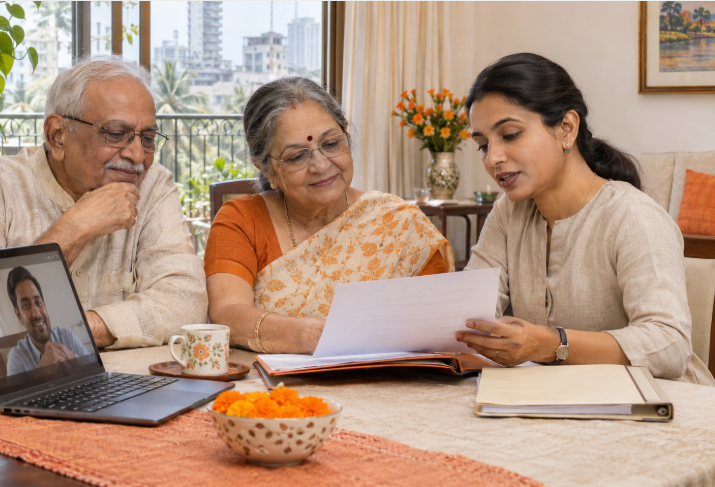

NRIs can manage much of a parent’s health insurance claim from abroad: keeping policy details ready, coordinating with the hospital’s insurance desk and the insurer or TPA, collecting documents and tracking queries. Signatures, consent forms and hospital desk visits usually need your parent or an authorised local person, and the claim decision always rests with the insurer.
This guide covers claims under a policy your parents already hold. For the wider picture of supporting parents from overseas, see our guide on how NRI families can support ageing parents in India, and for home care more broadly, our complete guide to elderly care at home in India.
What Is the Difference Between Cashless and Reimbursement Claims?
In a cashless claim, the insurer pays the approved amount directly to a network hospital. In a reimbursement claim, the family pays the hospital first and then claims the eligible amount back. Which route applies depends on the hospital and the policy terms.
| Aspect | Cashless claim | Reimbursement claim |
|---|---|---|
| Hospital | A network hospital of the insurer or its TPA | Any hospital, subject to the policy terms |
| Who pays the hospital | The insurer pays the approved amount; the family pays the rest | The family pays the full bill first |
| Key step | The hospital requests pre authorisation from the insurer | The family submits a claim with documents after discharge |
| Common issues | Partial approval and items the policy does not pay for | Deductions and requests for more documents |
A TPA, or Third Party Administrator, is a company some insurers use to process claims; the health card shows whether one is involved.
IRDAI’s Master Circular on Health Insurance Business (May 2024) requires insurers to decide on cashless authorisation requests within one hour and to give final discharge authorisation within three hours of the hospital’s request. These timelines govern when the insurer decides, not whether a claim is approved.
How Does a Cashless Claim Work When Your Parent Is Admitted?
A cashless claim moves through the hospital’s insurance desk, which sends requests to the insurer or TPA at each stage:
- Check that the hospital is in the insurer’s network, using the insurer’s website, app, or TPA helpline.
- At admission, the hospital’s insurance desk submits a pre-authorization request with the policy details, identity proof, and the doctor’s estimate. For planned treatment, this can be done in advance.
- The insurer or TPA approves, partly approves, raises a query, or declines the request.
- If costs rise during the stay, the hospital requests an enhancement.
- At discharge, the hospital sends the final bill for authorisation, and the family pays any amount the policy does not cover, such as co-payments or non-payable items.
Keep funds ready for deposits and uncovered costs.
What Documents Are Usually Needed for a Reimbursement Claim?
A reimbursement claim usually needs a claim form and the medical and billing papers from the hospital stay. The exact list is in your parents’ policy wording and the insurer’s claims page. Commonly requested documents include:
- The insurer’s claim form, signed by the insured person or policyholder.
- The discharge summary.
- The final hospital bill with an itemised breakdown, and payment receipts.
- Pharmacy bills with the matching prescriptions.
- Investigation reports, such as blood tests and scans.
- A copy of the policy or health card, and identity documents as required by the insurer.
- Bank details of the account where the insurer will pay the claim.
The same IRDAI master circular states that insurers and TPAs should collect the required documents from hospitals once a claim is intimated. Still keep a full set of copies yourself, because queries often come back to the family. Policies also set deadlines for informing the insurer and submitting claims, so check them early.
Who Can Sign Consent Forms and Authorise Claim Work?
An NRI child or a care manager does not automatically have authority to sign consent forms, access medical records or manage a claim. The requirements depend on the patient, the hospital, the insurer and the applicable rules.
- Hospital consent: your parent signs if they are able to. If they cannot, the hospital will explain whose consent it accepts.
- Medical records: hospitals may need your parent’s written consent before sharing records with anyone else.
- Insurer paperwork: claim forms are usually signed by the insured person or policyholder, and payment generally goes to their account. Some insurers accept an authorisation letter so another person can follow up. Ask the insurer in writing what it accepts.
- When your parent cannot sign: ask the hospital and insurer what they require, and take legal advice on arrangements such as a power of attorney.
Discuss these wishes with your parents before an emergency.
How Can Families Coordinate Parents, Hospitals, Insurers and TPAs?
Coordination works when each person knows their part and everyone uses one claim file:
- Your parent: decisions about treatment, signatures and consent.
- A local person: visits to the hospital insurance desk, original papers and collecting bills.
- The NRI child: the policy file, calls and emails to the insurer or TPA, payments and tracking.
- The hospital insurance desk: pre-authorisation, enhancement and discharge requests.
- The insurer or TPA: decisions, queries and settlement.
Keep scanned copies of every document in a shared family folder.
How Should You Track Claim Queries and Progress?
Track a claim by recording its number, keeping every message in writing, and answering queries quickly. Practical steps:
- Note the claim or pre-authorisation number and use it in every message.
- Send queries and replies in writing, and when a document is requested, send exactly that and note the date.
- Check status through the insurer’s portal or app rather than relying on phone calls.
- If you disagree with a decision, ask for the reasons in writing and contact the insurer’s grievance officer.
- If the insurer does not resolve the complaint, you can register it on IRDAI’s Bima Bharosa portal and, if needed, approach the Insurance Ombudsman.
What Can NRIs Handle Remotely, and What Needs Local Help?
Much of the claim work can be done from abroad, but some steps need someone present.
What NRIs can usually handle remotely
- Keeping the policy, health card, and identity copies ready.
- Checking network hospitals and policy coverage.
- Calling and emailing the insurer or TPA, and tracking the claim.
- Reviewing bills, settlement letters and deductions, and paying the hospital online.
What usually needs local help
- Being at the hospital insurance desk during admission and discharge.
- Collecting original documents and arranging signatures.
- Submitting physical papers where the insurer requires them.
Discharge papers matter for both the claim and recovery, so our guide on arranging home care after hospital discharge also explains which documents to collect.
How Pranyaas Supports Insurance Claims for Parents
Pranyaas offers health insurance claim support for elderly parents through its Insurance Assistance service. According to that page, a Care Manager summarises the policies your parents hold, tracks renewals, handles pre authorisation and the cashless desk in person at admission, and collects papers and follows up claims after discharge. Premiums are paid directly to the insurer, and approval and settlement remain the insurer’s decision. This support is available in Mumbai, Pune and Navi Mumbai, with your parents’ consent.
Frequently Asked Questions About Parents’ Health Insurance Claims
Can I manage my parent’s health insurance claim from abroad?
You can handle much of the coordination, including calls, emails and tracking. Signatures, consent forms and original papers may need your parent or someone local, depending on the hospital and the insurer.
Will the insurer pay the claim into my bank account?
Usually not. Claims are generally paid to the insured person or policyholder under the policy terms. Check with the insurer before submitting.
What happens if cashless approval is denied?
Ask for the reason in writing. If the policy covers the treatment, you can usually pay the hospital and file a reimbursement claim afterwards, although the insurer will assess it under the policy terms.
How long do we have to submit a reimbursement claim?
The deadline is set in the policy wording and varies between insurers. Read the claims section of the policy and submit as soon as possible after discharge.
Can a care manager handle the claim for my parents?
A care manager can coordinate, collect documents, and follow up with your parents’ consent. Who may sign forms or receive information is decided by the hospital and the insurer, so confirm their requirements first.
Getting Local Support With Your Parents’ Insurance Claims
Managing a claim from abroad is easier with a complete policy file and someone local who can stand at the hospital desk. If your parents live in Mumbai, Pune or Navi Mumbai, talk to Pranyaas about support with their policy and claims.
Discuss Insurance Claim Support



Leave A Comment