

24/7
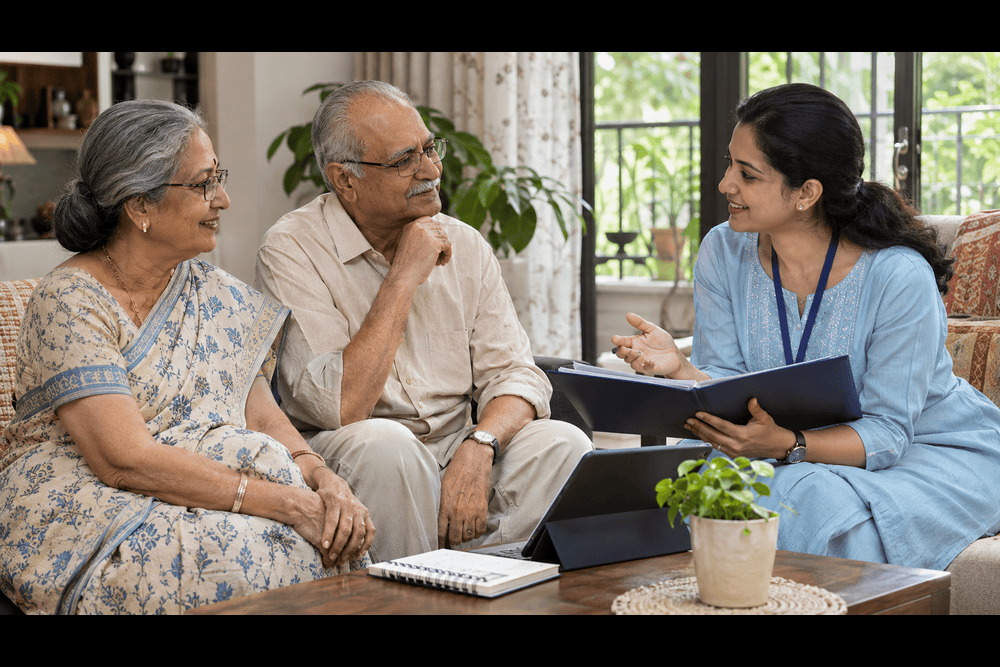

A care manager for elderly parents in India coordinates their care rather than providing it hands on. They assess needs, arrange doctors, nurses and attendants, track medicines and appointments, step in during emergencies and keep adult children informed. Clinical decisions stay with doctors, and daily physical help comes from caregivers or nurses.
When parents and children live in different cities, the hardest part of care is knowing who is responsible for what, and noticing when something slips. A care manager fills that gap. For a wider view of home care options, see our family guide to elderly care at home in India.
An elder care manager handles the organisation around your parents’ health and daily life: assessing what they need, arranging the right people, checking that plans are followed and reporting back to the family. Typical responsibilities include:
A care manager does not diagnose illness, prescribe or change medicines, or carry out clinical procedures, unless they hold a separate clinical qualification and are acting in that role. They also do not replace the doctor’s judgement or your parents’ own decisions.
In practice, this means:
The four roles work together, but each has a different job: the care manager organises, the caregiver assists, the nurse performs clinical tasks and the doctor decides on treatment.
| Role | Main focus | Typical tasks | Outside their role |
|---|---|---|---|
| Care Manager | Coordination and oversight | Assessing needs, arranging services, tracking appointments and medicines, updating the family | Diagnosing, prescribing, clinical procedures |
| Caregiver or attendant | Daily assistance | Bathing, dressing, help with moving, meals, reminders, company | Injections, changing medicines, medical decisions |
| Qualified nurse | Clinical care at home | Injections, wound care, catheter care, monitoring as prescribed | Changing the treatment plan without the doctor |
| Doctor | Medical assessment and treatment | Diagnosis, prescriptions, referrals, advising home or hospital care | Day to day organisation of care at home |
If you are deciding how to hire hands-on support, our comparison of independent caregivers and elder care agencies covers supervision, replacement and agreements.
A care manager coordinates providers by keeping one shared record and acting as the link between them. Without that link, each doctor sees only part of the picture, and the attendant may not know what changed at the last visit.
A typical routine:
Hypothetical example: A 79-year-old mother lives alone and sees a heart specialist and a diabetes specialist, while her son works abroad. After the heart specialist adjusts one tablet, the care manager updates the medicine list, tells the attendant about the new timing, mentions the change at the next diabetes review and sends the son a summary that evening.
To run this yourself, follow our guide on how families can manage medical appointments for elderly parents.
Your family may need a care manager when organising care has become more than the family can handle reliably, especially from another city or country. Common signs include:
For the health related signs in more detail, see when elderly parents need professional healthcare assistance at home. A care manager may be less necessary when parents are independent, see one doctor and have family nearby who can step in.
Ask questions that show who the care manager works for, what they are responsible for and what happens when something goes wrong:
Involve your parents too. A care manager works well when your parent sees them as support, not supervision, and agrees to what is shared with the family.
Pranyaas assigns each family a dedicated Care Manager who is a direct Pranyaas employee, background-verified, and matched to speak the parents’ language. According to its service pages, the Care Manager arranges and follows up on services, goes with parents to doctor appointments where the plan includes this, and shares the doctor’s advice with the family. Nurses and attendants are arranged through its healthcare partner, Ayushya Healthcare, with the Care Manager supervising the placement.
Pranyaas provides care at home in Mumbai, Pune and Navi Mumbai, and families can set it up remotely. The plan fee covers the Care Manager and coordination, while doctors, nurses, medicines, tests and equipment are billed separately at actual cost. You can see what is covered under medical and nursing support coordinated by a Care Manager.
The terms overlap. In India, titles and training vary between providers, so ask what qualifications the care manager has and which tasks they are allowed to carry out.
A care manager can organise medicines, check stock, set up reminders and report missed doses. Giving injections is a clinical task for a qualified nurse following the doctor’s prescription, and only the treating doctor should change which medicines your parent takes or how much.
Often, yes, if your parent agrees and the doctor or hospital accepts it. Some hospitals ask for the patient’s written consent before discussing their care with anyone else. Confirm your parent’s wishes first, and keep their consent in writing where it is required.
Possibly. A care manager visits for limited periods. If your parent needs daily help with bathing, meals or moving around, you will also need a caregiver, and the care manager can help arrange and supervise them.
It depends on the provider and plan, from monthly to weekly or more often. Ask for the visit frequency and length in writing, and what happens between visits.
A care manager gives your family one person who holds the whole picture of your parents’ care, while doctors, nurses and caregivers do the work they are trained for. If your parents live in Mumbai, Pune or Navi Mumbai, talk to Pranyaas about their needs, and a Care Manager can explain how support could fit around their routine.



Leave A Comment